om in mandukya upanishad 4 states of supreme awareness
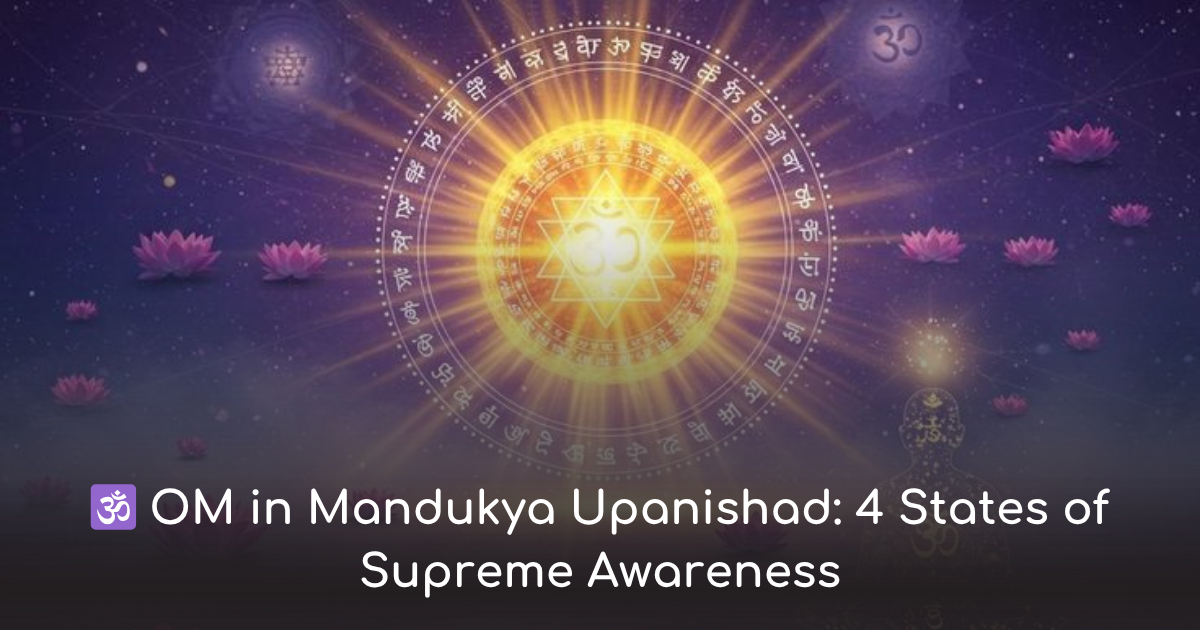
OM in Mandukya Upanishad reveals 4 states of consciousness that awaken true self-realization. Learn how to transcend illusion and discover the divine.
Journey Begins: Awakening Through OM
🌅 OM in Mandukya Upanishad – A Spiritual Key 🔑
OM in Mandukya Upanishad is not merely a sound or a symbol—it is a profound map that reveals the very core of our consciousness. Among the 108 Upanishads, the Mandukya Upanishad is the shortest—just 12 mantras—but its depth is infinite. Adi Shankaracharya once said, “Mandukya alone is sufficient for liberation if properly understood.”
In this blog, we will uncover the sacred four states of awareness that the Mandukya Upanishad attributes to OM. These are not philosophical abstractions, but your daily lived experience—waiting to be recognized, understood, and transcended.
✨ Have you ever asked:
“What lies beyond my waking thoughts?”
“Who dreams inside me?”
“Where do I go in deep sleep?”
“Is there a fourth realm, a silent witness of all these states?”
Let us walk together—like a seeker and a guru—into the ancient yet ever-relevant wisdom of OM in Mandukya Upanishad.
👉 Also explore previous gems in this sacred OM Series:
• OM: Powerful Truths That Will Elevate Your Soul in 2025
• OM vs AUM: Powerful Secrets to Awaken Your Inner Light
🌌 What Are the 4 States of Consciousness in Mandukya Upanishad?
According to OM in Mandukya Upanishad, the sacred syllable OM represents four states of the Self:
-
Vaishvanara (Waking) – A (अ)
-
Taijasa (Dreaming) – U (उ)
-
Prajna (Deep Sleep) – M (म)
-
Turiya (Transcendental State) – Silence (अमात्रा)
These are not just mental or emotional phases. They represent levels of existence, layers of illusion, and portals to ultimate truth.
OM is not just a chant—it is a roadmap.
Every letter, every vibration of OM, leads the seeker closer to Supreme Awareness.
1️⃣ Vaishvanara: The Waking State 👁️
"He whose sphere of activity is the external world, who is conscious of the external world, who has seven limbs and nineteen mouths and who enjoys the gross objects of the world, is Vaishvanara." — Mandukya Upanishad, Mantra 3
This is the state in which we live most of our lives—the waking state.
We interact with the physical world, think, plan, act, and perceive through our five senses. This is the realm of names, forms, and dualities: good vs evil, pain vs pleasure, success vs failure.
In this state, the Self is known as Vaishvanara.
-
Symbol in OM: The sound "A" (अ)
-
Quality: Outward-moving, transactional
-
Example: Like the surface of the ocean, restless and full of waves
But here's the catch—though it feels “real,” this is the most illusion-filled state. The external world is constantly changing. Identifying with this layer means we’re trapped in impermanence.
❗ Sanatan Insight:
Vaishvanara represents the soul trapped in Maya (illusion), always chasing the world and forgetting the Self.
2️⃣ Taijasa: The Dream State 💤
"The dream state is when the consciousness is turned inward, experiences subtle objects, and the Self becomes known as Taijasa." — Mandukya Upanishad, Mantra 4
As night falls and the senses turn inward, we slip into the dream state. Here, the mind creates its own world—a projection made of impressions, memories, and desires.
The experiencer in this state is called Taijasa, meaning "full of light."
-
Symbol in OM: The sound "U" (उ)
-
Quality: Inward-moving, subtle, semi-conscious
-
Example: Like the reflected moonlight—not fully real, not fully unreal
In dreams, the boundaries of the body vanish. We become whoever we imagine—rich, poor, flying, falling. And yet, the dream ends. We wake up... or do we?
❗ Sanatan Insight:
Just like dreams vanish when we wake, this waking life too will dissolve when we reach the ultimate awakening—Turiya.
🧘 Real-World Wisdom: Why Do These States Matter?
-
Most people identify only with the waking world, assuming it’s the only truth.
-
But dreams are equally immersive, aren’t they?
-
Deep sleep reveals a blissful silence. But we aren’t aware of it.
-
And Turiya? It is always present—watching all three.
If you don’t understand the waking, dreaming, and deep sleep states, how can you realize that you are beyond them all?
🕉️ OM: More Than Sound – A Spiritual GPS
Let’s pause and remember—OM is not chanted for musical rhythm.
It’s chanted to tune our being to its 4 levels:
| OM Sound | State | Identity | Awareness |
|---|---|---|---|
| A (अ) | Waking | Vaishvanara | External |
| U (उ) | Dreaming | Taijasa | Inward |
| M (म) | Deep Sleep | Prajna | Causal |
| (Silence) | Turiya | Pure Self | Beyond |
Each repetition of OM is like opening a door...
Until the final silence reveals what words never can.
🔚 What Comes Next?
In the next section, we will explore:
-
The mysterious state of Prajna — the deep sleep state
-
The glorious truth of Turiya — the unchanging Self
-
And how OM contains it all, within and beyond sound
🧭 Remember: You are not your thoughts, not your body, not even your dreams.
You are that Supreme Awareness which OM points to—Turiya.
Into the Depths: Prajna & The Mystery of Turiya
🌌 Recap of Our Journey So Far…
In the first section, we explored the first two states described in OM in Mandukya Upanishad:
-
Vaishvanara – Waking state, symbolized by “A”
-
Taijasa – Dreaming state, symbolized by “U”
Both are dualistic, active, and limited by perceptions.
But now, we enter the depths of consciousness, where identity begins to dissolve, and the truth becomes closer and clearer.
3️⃣ Prajna: The Deep Sleep State 🌑
“That is the state of deep sleep where the sleeper desires no desire and sees no dream. The Self becomes one with pure consciousness—Prajna.” — Mandukya Upanishad, Mantra 5
We now reach the third state of awareness—deep, dreamless sleep. This is not a state of ignorance, but a state of unmanifest potential.
✨ What is Prajna?
-
Prajna literally means “pure intelligence” or “awareness itself”
-
In this state, there is no ego, no thought, no object
-
There is only bliss—but it is unconscious bliss
🕉 In OM:
-
Represented by the sound “M” (म)
-
Symbol of merging, stillness, and the veil before awakening
-
Nature: Unified consciousness with no duality—but also no awareness of that unity
💭 You don’t know you’re in deep sleep—but you wake up saying:
“I slept so peacefully. I didn’t know a thing.”
That “I” was Prajna—the seed of all experience.
🧩 Real-Life Analogy:
Think of Prajna as the seed that contains the entire tree of waking and dreaming.
-
The waking state is the fruit
-
The dreaming state is the branch
-
But Prajna—the deep sleep state—is the unmanifest origin of them all
Yet, this is not the final state.
4️⃣ Turiya: The Fourth — The Ultimate State 🔱
“That which is not conscious of the inner, nor of the outer, nor both; which is unseeable, ungraspable, beyond the senses, indescribable, the cessation of phenomena, tranquil, auspicious, and non-dual—THAT is the Self. THAT is to be realized.” — Mandukya Upanishad, Mantra 7
This is Turiya — literally meaning “the fourth”.
But Turiya is not just another state—it is the eternal ground in which all other states arise and disappear.
🌟 Turiya is:
-
Not a state of doing or knowing, but of being
-
The witness of waking, dreaming, and deep sleep
-
The conscious presence that is never absent
🕉 In OM:
-
Symbolized by Silence after A-U-M
-
Silence is not emptiness—it is infinite fullness beyond expression
📜 Scriptural Insight:
In the Mandukya Karika, Gaudapada (Adi Shankaracharya’s teacher’s guru) explains:
“Turiya is the Self. It is the Supreme. It is beyond cause and effect, beyond birth and death. Knowing this, the wise become free.”
This state is beyond the physical, mental, and even the causal layers of the self.
It is non-dual consciousness, where the seer and the seen become one.
🌊 From OM to Brahman: The Subtle Bridge
OM is not merely symbolic—it is a sound bridge to Brahman, the ultimate reality.
Each syllable dissolves the illusion of separateness and leads us to Turiya:
| Sound | State | Seeker's Transformation |
|---|---|---|
| A | Waking | Awareness of the outer world |
| U | Dreaming | Awareness of the inner world |
| M | Deep sleep | Awareness of the source |
| (Silence) | Turiya | Awareness itself |
🔔 The silence after OM is not the end—it is the beginning of realization.
🧘♂️ Meditation Practice: Experiencing the Turiya Within
Chanting OM consciously, and listening deeply to the silence after chanting, helps the seeker touch the edge of Turiya.
🧿 Try This:
-
Sit in stillness, spine straight
-
Inhale slowly and deeply
-
Chant A-U-M slowly, feeling each vibration
-
Let yourself rest in the silence after M
-
Stay present — this is where Turiya begins to shine
Repeat daily. In time, that silence will feel more real than noise, more eternal than time.
🌈 Living with Awareness of Turiya
While we live in the world—working, studying, building relationships—the awareness of Turiya can stay with us.
-
In joy, it says: “This too shall pass.”
-
In sorrow, it whispers: “You are untouched.”
-
In silence, it shines: “You are That.”
This is not escapism. It is enlightened living.
🧭 Closing this section: What Comes Next?
In the next section, we’ll explore:
-
The symbolism of OM's 3 letters and the silence in detail
-
How OM aligns with modern psychology and consciousness research
-
Practical techniques to integrate the 4 states into daily life
-
And the final realization: You were Turiya all along.
🕊️ “Just as the sky remains untouched by the clouds,
the Self remains pure through all states.”
Beyond Words: OM, Silence, and Self-Realization
🧩 The Symbol of OM: More Than Just A Sound
By now, we've explored the four profound states of consciousness outlined in the Mandukya Upanishad:
-
Vaishvanara (A) – Waking State
-
Taijasa (U) – Dreaming State
-
Prajna (M) – Deep Sleep State
-
Turiya (Silence) – Supreme Awareness
But what ties them together?
🕉️ The sacred syllable OM is not merely a mantra — it is a cosmic equation, a map of the Self, and a gateway to moksha.
🔤 A-U-M and the Silence: Symbolism Decoded
🅰️ A – The Gross Body (Sthula Sharira)
-
Waking consciousness
-
Connection with the material world
-
Birth, actions, ego
🆄 U – The Subtle Body (Sukshma Sharira)
-
Mental and emotional layers
-
Inner world of thoughts, dreams
-
Desires, imagination
〽️ M – The Causal Body (Karana Sharira)
-
Deep sleep where identity is dissolved
-
Seed form of all karma
-
Bliss, yet unaware bliss
🔕 Silence – The Supreme Self (Atman or Brahman)
-
The eternal witness
-
Pure non-dual awareness
-
Timeless, formless, unborn
✨ “OM is the bow. The Self is the arrow. Brahman is the target.” – Mundaka Upanishad
🧘♂️ OM Meditation in Daily Life: A Practical Guide
Chanting OM mindfully is one of the most powerful meditative tools in Sanatan Dharma. It aligns all layers of your being with the truth of your real Self.
🧿 How to Practice:
-
Sit in Padmasana or comfortably with straight spine
-
Take 3 deep breaths — settle your thoughts
-
Chant OM slowly:
-
Feel the A in the stomach
-
The U in the chest
-
The M in the head
-
-
Rest in the silence after the sound — this is the gate to Turiya
Repeat this 5 to 11 times. Over time, the silence will become deeper than the sound.
🧬 OM and Modern Science: Bridging Ancient Wisdom & Neuroscience
Modern science is beginning to recognize what the rishis knew millennia ago.
🧠 Scientific Findings:
-
OM chanting activates the parasympathetic nervous system, reducing stress and increasing focus.
-
MRI studies show that chanting OM increases activity in the brain's prefrontal cortex, associated with self-awareness and emotional regulation.
-
OM vibrational chanting creates alpha and theta waves in the brain, which are linked to meditation and deep relaxation.
🎧 Even scientists now accept: Sound creates reality.
And OM, the original sound, holds the power of universal creation.
🧠 Psychology Meets Vedanta: The 4 States and the Human Mind
In psychology, we talk of:
-
Conscious Mind → Waking (Vaishvanara)
-
Subconscious Mind → Dreaming (Taijasa)
-
Unconscious Mind → Deep Sleep (Prajna)
-
Superconscious or Transcendental Awareness → Turiya
What Vedanta describes as Self-realization, modern psychology calls “peak consciousness” or “flow state” — a complete union with the present.
🌿 Mandukya simply adds one thing:
“You are not just passing through these states…
YOU are the Consciousness that witnesses them all.”
💡 Living with Mandukya Wisdom: Transform Your Life
🌞 What does it mean in daily life?
-
Don’t just react — observe your mind
-
Don’t fear dreams — learn from them
-
Don’t avoid silence — embrace it
-
Don’t identify with waking struggles — you are more than your body and mind
When you chant OM, you're not calling a deity.
You're awakening your eternal Self — the same Atman that is in you, in me, and in the cosmos.
🔁 Interlinked Wisdom (For Internal Linking)
If you loved this exploration, don’t miss other powerful articles in our OM Series:
🙏 Final Realization: The Self is OM, You Are That
“Ayam Atma Brahma” — This Self is Brahman
“Tat Tvam Asi” — You are That
Chant OM not as a ritual, but as a reminder of who you are.
The One that never sleeps, never dies, and never fears.
🧠 FAQs About OM in Mandukya Upanishad
1. What is the main teaching of the Mandukya Upanishad?
The Mandukya Upanishad teaches that OM is the symbol of the entire universe and that every individual is the Atman (Self) which is ultimately Brahman (Supreme Consciousness). It explains that through the four states of consciousness—waking, dreaming, deep sleep, and Turiya—we can understand our real nature and realize oneness with the Absolute.
2. Why are there only 12 verses in the Mandukya Upanishad?
Despite being the shortest of all Upanishads, its 12 mantras are considered the most profound. Each verse encapsulates deep metaphysical wisdom, focusing on the syllable OM and its connection to consciousness. It's often said that the Mandukya alone is sufficient for moksha if meditated upon with sincerity and depth.
3. What are the four states of consciousness in Mandukya?
The four states are:
-
Vaishvanara (Waking) – outward awareness through the senses,
-
Taijasa (Dreaming) – inward awareness of thoughts and images,
-
Prajna (Deep Sleep) – blissful but unaware,
-
Turiya – the pure witnessing consciousness, beyond body and mind.
4. What is Turiya and how is it different from sleep?
Turiya is the transcendental fourth state—beyond waking, dreaming, and deep sleep. Unlike deep sleep where the ego temporarily dissolves but awareness is absent, in Turiya the seeker is fully conscious and rooted in bliss. It is the state of true liberation and unity with Brahman.
Categories
Read More
🌱 Raising Dharma Warriors Introducing Yoga & Sanatan Values to Children and Teenagers in the Digital Age 📱 They know how to use Instagram filters, but do they know how to filter their thoughts? 👦🏽👧🏽 From toddlers glued to tablets to teenagers scrolling endlessly through reels, today’s youth are growing up in a hyper-digital, overstimulated, fast-paced world. While modern technology...

Explore the spiritual meaning of Lord Vishnu’s 10 avatars (Dashavatara), their purpose, names in Hindi, and symbolism across yugas. 🌟 Lord Vishnu’s 10 Avatars – The Divine Blueprint of Dharma In the eternal play of the universe, when Dharma (righteousness) declines and Adharma (unrighteousness) rises, Lord Vishnu — the preserver among the holy trinity — takes a...

Unlock the timeless power of Gayatri Mantra! Discover its meaning, benefits & chanting secrets for spiritual awakening and peace. A must-read for seekers. Gayatri Mantra: Unlocking the Divine Power of the Universal Prayer ✨ Introduction The Gayatri Mantra is a sacred and powerful chant that has echoed through the ages, guiding seekers toward divine wisdom and inner peace. Revered in...
Discover 5 powerful insights from Swamy Adi Shankaracharya Ji’s life, teachings & legacy that still inspire seekers of truth across the world. Swamy Adi Shankaracharya Ji: The Eternal Light of Sanatan Dharma and Advaita Philosophy Swamy Adi Shankaracharya Ji is one of the greatest spiritual luminaries in Indian history. His name echoes through the temples, scriptures, and hearts...

Ayurveda in Sanatan Dharm reveals sacred wisdom on health, harmony, and healing. Discover 7 timeless truths awakening pride in your Dharmic roots. Rediscovering the Roots of Dharmic Healing “When the soul walks with nature, the body remembers its divine rhythm.” – SanatanYug Wisdom 🔱 Introduction: A Seeker’s Calling Ayurveda in Sanatan Dharm is not just a method to...